
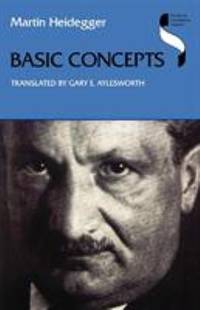
Basic Concepts Paperback - 1998
by Martin Heidegger
- Used
- Good
- Paperback
NZ$11.65
Free Delivery within USA
Standard delivery: 4 to 8 days
More delivery options
Standard delivery: 4 to 8 days
Details
- Title Basic Concepts
- Author Martin Heidegger
- Binding Paperback
- Edition New edition
- Condition Used - Good
- Pages 128
- Volumes 1
- Language ENG
- Publisher Indiana University Press, Bloomington, Indiana, U.S.A.
- Publication date 1998
- Features Glossary
- Bookseller's Inventory # G0253212154I3N00
- ISBN 9780253212153 / 0253212154
- Weight 0.39 lbs (0.18 kg)
- Dimensions 8.48 x 5.2 x 0.21 in (21.54 x 13.21 x 0.53 cm)
-
Themes
- Chronological Period: Modern
- Category Philosophy
- Library of Congress Catalogue Number 92046633
- Dewey Decimal Code 193
- Quantity available 2
About ThriftBooks Washington, United States
Biblio member since 2018
From the largest selection of used titles, we put quality, affordable books into the hands of readers
Reader reviews for Basic Concepts
Write a review for this book
Important Terms and Guidelines
- Please focus on the book’s content and context. Also, add any personal comments as to how you enjoyed the book. Substantiate your likes and dislikes. You may make comparisons to other books.
- Reviews must be at least 140 characters in length.
- Please do not reveal critical plot elements.
- This is not a help line. Contact customer support if you need help.
Your review must not include:
- Obscenities, discriminatory language, or other insulting language not suitable for public domain
- Advertisements, “spam” content, or references to other products, offers or websites.
- Email addresses, URLs, phone numbers, physical addresses or other contact information.
- Overly critical comments about other reviews or reviewers
- Time-sensitive material (i.e. promotional tours, seminars, lectures, etc.)
- Availability, price, or alternative ordering/shipping information
From the publisher
First line
Let us follow the ancient saying: "Take into care beings as a whole."
From the rear cover
Basic Concepts, one of the first texts to appear in English from the critical later period of Martin Heidegger's thought, strikes out in new directions. First published in German in 1981 as Grundbegriffe (volume 51 of Martin Heidegger's collected works), it is the text of a lecture course that Heidegger gave at Freiburg in the winter semester of 1941 during the phase of his thinking known as the "turning". In this transition Heidegger shifted his attention from the problem of the meaning of being to the question of the truth of being. The text consists of an introduction and two parts. In the introduction Heidegger explains the meaning of his title as "concepts of ground". Part One, divided into three sections, attempts to thematize the difference between being and beings. The first section takes up the metaphysical, logical, grammatical, and everyday meanings of the verb "to be" and shows their inadequacy. The second section, a strikingly original discussion, examines a series of eight directives for reflecting on being. The third section shifts from being toward man and points to the discord between the two. In Part Two, Heidegger interprets two fragments by Anaximander to recover an "incipient saying of Being" that is poetic rather than metaphysical. In this clear translation by Gary E. Aylesworth, Basic Concepts provides a concise introduction to Heidegger's later thought.

