
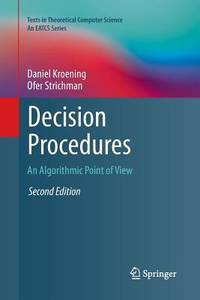
Stock photo: cover may vary
Decision Procedures: An Algorithmic Point of View (Texts in Theoretical Computer Science. An EATCS Series) Papeback -
by Daniel Kroening; Ofer Strichman
- New
NZ$167.10
NZ$7.17
Delivery within USA
Standard delivery: 9 to 14 days
More delivery options
Standard delivery: 9 to 14 days
Ships from Cold Books (New York, United States)
Details
- Title Decision Procedures: An Algorithmic Point of View (Texts in Theoretical Computer Science. An EATCS Series)
- Author Daniel Kroening; Ofer Strichman
- Binding Papeback
- Condition New
- Pages 356
- Volumes 1
- Language ENG
- Publisher Springer
- Publication date pp. 377
- Illustrated Yes
- Features Bibliography, Illustrated
- Bookseller's Inventory # 6384044966
- ISBN 9783662570654 / 3662570653
- Weight 1.17 lbs (0.53 kg)
- Dimensions 9.21 x 6.14 x 0.78 in (23.39 x 15.60 x 1.98 cm)
- Category Mathematics
- Dewey Decimal Code 519.542
- Quantity available 4
About Cold Books New York, United States
Reader reviews for Decision Procedures: An Algorithmic Point of View (Texts in Theoretical Computer Science. An EATCS Series)
Write a review for this book
Important Terms and Guidelines
- Please focus on the book’s content and context. Also, add any personal comments as to how you enjoyed the book. Substantiate your likes and dislikes. You may make comparisons to other books.
- Reviews must be at least 140 characters in length.
- Please do not reveal critical plot elements.
- This is not a help line. Contact customer support if you need help.
Your review must not include:
- Obscenities, discriminatory language, or other insulting language not suitable for public domain
- Advertisements, “spam” content, or references to other products, offers or websites.
- Email addresses, URLs, phone numbers, physical addresses or other contact information.
- Overly critical comments about other reviews or reviewers
- Time-sensitive material (i.e. promotional tours, seminars, lectures, etc.)
- Availability, price, or alternative ordering/shipping information
From the publisher
From the rear cover
A decision procedure is an algorithm that, given a decision problem, terminates with a correct yes/no answer. Here, the authors focus on theories that are expressive enough to model real problems, but are still decidable. Specifically, the book concentrates on decision procedures for first-order theories that are commonly used in automated verification and reasoning, theorem-proving, compiler optimization and operations research. The techniques described in the book draw from fields such as graph theory and logic, and are routinely used in industry.
The authors introduce the basic terminology of SAT, Satisfiability Modulo Theories (SMT) and the DPLL(T) framework. Then, in separate chapters, they study decision procedures for propositional logic; equalities and uninterpreted functions; linear arithmetic; bit vectors; arrays; pointer logic; and quantified formulas. They also study the problem of deciding combined theories based on the Nelson-Oppen procedure.
The first edition of this book was adopted as a textbook in courses worldwide. It was published in 2008 and the field now called SMT was then in its infancy, without the standard terminology and canonic algorithms it has now; this second edition reflects these changes. It brings forward the DPLL(T) framework. It also expands the SAT chapter with modern SAT heuristics, and includes a new section about incremental satisfiability, and the related Constraints Satisfaction Problem (CSP). The chapter about quantifiers was expanded with a new section about general quantification using E-matching and a section about Effectively Propositional Reasoning (EPR). The book also includes a new chapter on the application of SMT in industrial software engineering and in computational biology, coauthored by Nikolaj Bjrner and Leonardo de Moura, and Hillel Kugler, respectively.
Each chapter includes a detailed bibliography and exercises. Lecturers' slides and a C++ library forrapid prototyping of decision procedures are available from the authors' website.

