
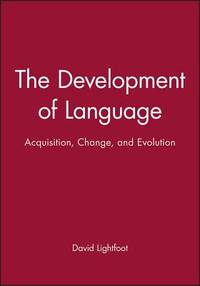
Stock photo: cover may vary
The Development of Language: Acquisition, Change, and Evolution (Blackwell/Maryland Lectures in Language and Cognition) Paperback - 1999 - 1st Edition
by Lightfoot, David
- Used
- Good
- Paperback
NZ$78.28
Free Delivery within USA
Standard delivery: 7 to 14 days
More delivery options
Standard delivery: 7 to 14 days
Dropship order
Ships from Bonita (California, United States)
Details
- Title The Development of Language: Acquisition, Change, and Evolution (Blackwell/Maryland Lectures in Language and Cognition)
- Author Lightfoot, David
- Binding Paperback
- Edition number 1st
- Edition 1
- Condition Used - Good
- Pages 300
- Volumes 1
- Language ENG
- Publisher Wiley-Blackwell, Malden, MA, U.S.A.
- Publication date 1999-01-05
- Illustrated Yes
- Features Bibliography, Illustrated, Index
- Bookseller's Inventory # 0631210601.G
- ISBN 9780631210603 / 0631210601
- Weight 1.12 lbs (0.51 kg)
- Dimensions 9.03 x 6.03 x 0.93 in (22.94 x 15.32 x 2.36 cm)
- Category Language Arts / Linguistics / Literacy
- Library of Congress subjects Grammar, Comparative and general, Language acquisition
- Library of Congress Catalogue Number 98028674
- Dewey Decimal Code 401.93
- Quantity available 1
About Bonita California, United States
Reader reviews for The Development of Language: Acquisition, Change, and Evolution (Blackwell/Maryland Lectures in Language and Cognition)
Write a review for this book
Important Terms and Guidelines
- Please focus on the book’s content and context. Also, add any personal comments as to how you enjoyed the book. Substantiate your likes and dislikes. You may make comparisons to other books.
- Reviews must be at least 140 characters in length.
- Please do not reveal critical plot elements.
- This is not a help line. Contact customer support if you need help.
Your review must not include:
- Obscenities, discriminatory language, or other insulting language not suitable for public domain
- Advertisements, “spam” content, or references to other products, offers or websites.
- Email addresses, URLs, phone numbers, physical addresses or other contact information.
- Overly critical comments about other reviews or reviewers
- Time-sensitive material (i.e. promotional tours, seminars, lectures, etc.)
- Availability, price, or alternative ordering/shipping information
From the publisher
First line
Anybody who has attended a performance of Othello or read the King James version of the Bible knows that English has changed over the last 400 years.
From the rear cover
How and why do languages change over time? Could the way an individual child develops affect aggregate language change? What do the mechanisms of change tell us about the evolution of language in our species?
To answer these questions, David Lightfoot looks closely at young children. A child develops a grammar on exposure to some triggering experience. A small perturbation in the trigger may entail a different grammar in the next population of speakers, with dramatic effects. This "sensitive dependence on initial conditions" is the key to explaining how languages change, and why they change in fits and starts.
The "cue-based" approach to language acquisition presented here is a radical departure from formal models of language learning. Lightfoot challenges conventional understanding by showing that language change is essentially contingent - unpredictable but explainable; and he contests how far natural selection enables us to understand the evolution of the language faculty in the species.

