BIBLIO is the largest independent book marketplace in the world, with over 100 million books.

Skip to content

New Centrality Measures in Networks: How to Take into Account the Parameters of the Nodes and Group Influence of Nodes to Nodes

New Centrality Measures in Networks: How to Take into Account the Parameters of the Nodes and Group Influence of Nodes to Nodes

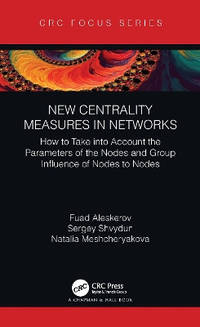
New Centrality Measures in Networks: How to Take into Account the Parameters of the Nodes and Group Influence of Nodes to Nodes Hardback - 2021

by Fuad Aleskerov

Add to wish list
  • New
  • Hardback
New

Description

Hardback. New.
Ask the seller a question Add to wish list
NZ$130.19
NZ$23.29 Delivery to USA
Standard delivery: 14 to 21 days
More delivery options
Ships from The Saint Bookstore (Merseyside, United Kingdom)

Details

  • Title New Centrality Measures in Networks: How to Take into Account the Parameters of the Nodes and Group Influence of Nodes to Nodes
  • Author Fuad Aleskerov
  • Binding Hardback
  • Condition New
  • Pages 102
  • Volumes 1
  • Language ENG
  • Publisher CRC Press
  • Publication date 2021-12-07
  • Illustrated Yes
  • Features Bibliography, Illustrated, Index
  • Bookseller's Inventory # A9781032063195
  • ISBN 9781032063195 / 103206319X
  • Weight 0.62 lbs (0.28 kg)
  • Dimensions 8.5 x 5.5 x 0.31 in (21.59 x 13.97 x 0.79 cm)
  • Category Technology & Industrial Arts
  • Library of Congress subjects System analysis - Mathematics, Network analysis (Planning) - Mathematics
  • Library of Congress Catalogue Number 2021040809
  • Dewey Decimal Code 003
  • Quantity available 1

About The Saint Bookstore Merseyside, United Kingdom

Biblio member since 2018

The Saint Bookstore specialises in hard to find titles & also offers delivery worldwide for reasonable rates.

Terms of Sale: Refunds or Returns: A full refund of the price paid will be given if returned within 30 days in undamaged condition. If the product is faulty, we may send a replacement.

Browse books from The Saint Bookstore

Reader reviews for New Centrality Measures in Networks: How to Take into Account the Parameters of the Nodes and Group Influence of Nodes to Nodes

From the publisher

Over the last number of years there has been a growing interest in the analysis of complex networks which describe a wide range of real-world systems in nature and society. Identification of the central elements in such networks is one of the key research areas. Solutions to this problem are important for making strategic decisions and studying the behavior of dynamic processes, e.g. epidemic spread. The importance of nodes has been studied using various centrality measures. Generally, it should be considered that most real systems are not homogeneous: nodes may have individual attributes and influence each other in groups while connections between nodes may describe different types of relations. Thus, critical nodes detection is not a straightforward process.

New Centrality Measures in Networks presents a class of new centrality measures which take into account individual attributes of nodes, the possibility of group influence and long-range interactions and discusses all their new features. The book provides a wide range of applications of network analysis in several fields - financial networks, international migration, global trade, global food network, arms transfers, networks of terrorist groups, and networks of international journals in economics. Real-world studies of networks indicate that the proposed centrality measures can identify important nodes in different applications. Starting from the basic ideas, the development of the indices and their advantages compared to existing centrality measures are presented.

Features

  • Built around real-world case studies in a variety of different areas (finance, migration, trade, etc.)
  • Suitable for students and professional researchers with an interest in complex network analysis
  • Paired with a software package for readers who wish to apply the proposed models of centrality (in Python) available at https: //github.com/SergSHV/slric.

About the author

Professor Fuad Aleskerov graduated from the Mathematical Department of Moscow State University in 1974. He is the Head of the International Center of Decision Choice and Analysis, Head of the Department of Mathematics for Economics, National Research University Higher School of Economics (HSE University); he also holds the Mark Aizerman Chair on Choice Theory and Decision Analysis, Trapeznikov Institute of Control Sciences of the Russian Academy of Sciences. Aleskerov is on the editorial board for 16 journals, has published ten books and more than 150 articles in peer-reviewed journals, and has presented invited papers at more than 160 international conferences. He is a member of several international scientific societies including Academia Europaea.

Sergey Shvydun earned his PhD degree (cum laude) in Applied Mathematics from the National Research University Higher School of Economics (HSE University) in 2020. He is a senior research fellow at HSE's International Center of Decision Choice and Analysis and an associate professor at the Department of Mathematics in the HSE Faculty of Economic Sciences. He is also a senior research fellow at the Laboratory on Choice Theory and Decision Analysis of the Trapeznikov Institute of Control Sciences of the Russian Academy of Sciences. His research interests are in data analysis, social choice theory and social networks analysis.

Natalia Meshcheryakova is a PhD student in Computer Science at the National Research University Higher School of Economics (HSE University). She received a Master Degree of Computer Science from the HSE University in 2018. She is a research fellow at HSE's International Center of Decision Choice and Analysis and a lecturer at the Department of Mathematics in the HSE Faculty of Economic Sciences. She is also a research fellow at the Laboratory on Choice Theory and Decision Analysis of the Trapeznikov Institute of Control Sciences of the Russian Academy of Sciences. Her research interests include social networks, machine learning and data analysis.

tracking-