
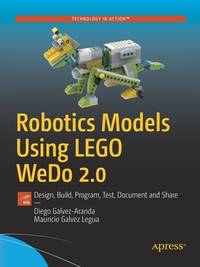
Stock photo: cover may vary
Robotics Models Using Lego Wedo 2.0: Design, Build, Program, Test, Document and Share Paperback - 2021
by Galvez-aranda, Diego
- New
- Paperback
NZ$117.41
NZ$35.12
Delivery to USA
Standard delivery: 7 to 14 days
More delivery options
Standard delivery: 7 to 14 days
Ships from Revaluation Books (Devon, United Kingdom)
Details
- Title Robotics Models Using Lego Wedo 2.0: Design, Build, Program, Test, Document and Share
- Author Galvez-aranda, Diego
- Binding Paperback
- Condition New
- Pages 362
- Volumes 1
- Language ENG
- Publisher Apress
- Publication date 2021
- Illustrated Yes
- Features Illustrated
- Bookseller's Inventory # x-1484268458
- ISBN 9781484268452 / 1484268458
- Weight 1.88 lbs (0.85 kg)
- Dimensions 11 x 8.25 x 0.78 in (27.94 x 20.96 x 1.98 cm)
- Category Computers - General Information
- Quantity available 2
About Revaluation Books Devon, United Kingdom
Biblio member since 2020
General bookseller of both fiction and non-fiction.
Reader reviews for Robotics Models Using Lego Wedo 2.0: Design, Build, Program, Test, Document and Share
Write a review for this book
Important Terms and Guidelines
- Please focus on the book’s content and context. Also, add any personal comments as to how you enjoyed the book. Substantiate your likes and dislikes. You may make comparisons to other books.
- Reviews must be at least 140 characters in length.
- Please do not reveal critical plot elements.
- This is not a help line. Contact customer support if you need help.
Your review must not include:
- Obscenities, discriminatory language, or other insulting language not suitable for public domain
- Advertisements, “spam” content, or references to other products, offers or websites.
- Email addresses, URLs, phone numbers, physical addresses or other contact information.
- Overly critical comments about other reviews or reviewers
- Time-sensitive material (i.e. promotional tours, seminars, lectures, etc.)
- Availability, price, or alternative ordering/shipping information
From the publisher
From the rear cover
Build 12 robotics models using LEGO WeDo 2.0. This book features models created especially to introduce LEGO enthusiasts to hardware and software concepts while creating robots inspired by natural wildlife.
You'll learn the basics behind different mechanisms and principals required to build walking robots. Simultaneously, make your model "come to life" by incorporating powerful yet simple programming techniques. For every model, go through all the phases to explore each robot's functionality, solve problems using creativity, identify issues, and propose solutions.
You'll learn the basics behind different mechanisms and principals required to build walking robots. Simultaneously, make your model "come to life" by incorporating powerful yet simple programming techniques. For every model, go through all the phases to explore each robot's functionality, solve problems using creativity, identify issues, and propose solutions.
The author's expertise working in education, mathematics, programming, electronic, and robotics came together to produce this book. The methodology used is designed to help you discover new knowledge, that has been used historically in science. It relies on observation, measurement, experimentation and formulation, analysis, and modification of hypotheses. All activities are carried outfollowing the methodology created by the authors called 5 phases of educational robotics (5PER), which are: design, construction, programming, testing and, finally, documenting and sharing
With Robotics Models Using LEGO WeDo 2.0 you'll create solutions to specific, tangible problems while building fun and engaging LEGO models and learning to program them to accomplish basic tasks.
You will:
- Create your own LEGO WeDo 2.0 inventions using the design principles in this book
- Understand the mechanics behind animal motions by developing robotic prototypes and how they interact with our environment through the use of sensors and actuators
- Solve problems by using an iconographic programming language for the implementation of algorithms

