
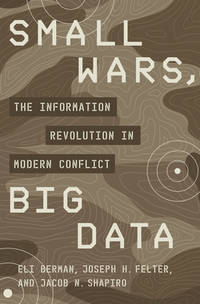
Stock photo: cover may vary
Small Wars, Big Data – The Information Revolution in Modern Conflict Hardback - 2018
by Berman, Eli/ Felter, Joseph H./ Shapiro, Jacob N
- New
- Hardback
NZ$64.50
NZ$35.12
Delivery to USA
Standard delivery: 7 to 14 days
More delivery options
Standard delivery: 7 to 14 days
Ships from Revaluation Books (Devon, United Kingdom)
Details
- Title Small Wars, Big Data – The Information Revolution in Modern Conflict
- Author Berman, Eli/ Felter, Joseph H./ Shapiro, Jacob N
- Binding Hardback
- Condition New
- Pages 408
- Volumes 1
- Language ENG
- Publisher Princeton Univ Pr
- Publication date 2018
- Illustrated Yes
- Features Bibliography, Illustrated, Index
- Bookseller's Inventory # __0691177074
- ISBN 9780691177076 / 0691177074
- Weight 1.54 lbs (0.70 kg)
- Dimensions 9.4 x 6.1 x 1.3 in (23.88 x 15.49 x 3.30 cm)
- Category Technology & Industrial Arts
- Library of Congress subjects Insurgency, Asymmetric warfare
- Library of Congress Catalogue Number 2017959003
- Quantity available 1
About Revaluation Books Devon, United Kingdom
Biblio member since 2020
General bookseller of both fiction and non-fiction.
Reader reviews for Small Wars, Big Data – The Information Revolution in Modern Conflict
Write a review for this book
Important Terms and Guidelines
- Please focus on the book’s content and context. Also, add any personal comments as to how you enjoyed the book. Substantiate your likes and dislikes. You may make comparisons to other books.
- Reviews must be at least 140 characters in length.
- Please do not reveal critical plot elements.
- This is not a help line. Contact customer support if you need help.
Your review must not include:
- Obscenities, discriminatory language, or other insulting language not suitable for public domain
- Advertisements, “spam” content, or references to other products, offers or websites.
- Email addresses, URLs, phone numbers, physical addresses or other contact information.
- Overly critical comments about other reviews or reviewers
- Time-sensitive material (i.e. promotional tours, seminars, lectures, etc.)
- Availability, price, or alternative ordering/shipping information
From the publisher
From the rear cover
"This seminal work examines an extensive body of evidence from more than a decade of scholarship on modern asymmetric conflict, and provides compelling insights on what is effective, and what is not, in today's small wars. The soldier-scholar authors, who served in the wars they describe, have produced a book that should be required reading for military leaders, policymakers, development professionals, and diplomats."--Retired U.S. Army General David H. Petraeus
"Berman, Felter, and Shapiro have synthesized a great deal of 'big data' from many recent conflicts to produce a fascinating account of how different types of armed interventions produce different kinds of results, above all in the crucial matter of the flow of information from civilians to counterinsurgents. This well-written book will greatly interest all those working in war zones and those who study warfare."--Peter Bergen, author of United States of Jihad: Who Are America's Homegrown Terrorists and How Do We Stop Them?
"Small Wars, Big Data heralds a revolution in conflict studies, one that finally brings development, defense, and diplomacy together at the operational level and provides real tools for policymakers and practitioners alike. This book melds rigorous empirical research with collaborative scholarship and great storytelling: a breakthrough for political science."--Anne-Marie Slaughter, president and CEO of New America
"Small Wars, Big Data explores the remarkable possibilities and also inherent limitations of using advanced techniques to gather and analyze information in support of counterinsurgency campaigns. Packed with evidence and examples, this book makes a stimulating and challenging contribution to understanding the role of social science in the conduct of modern war."--Lawrence Freedman, author of The Future of War: A History
"This highly ambitious book unpacks the single biggest foreign policy question of the post-9/11 era--the nature of intrastate conflict. Clearly motivated by a desire to better understand the wars fought by the United States and to improve foreign policy, this book is a must-read for the US military. It will land on undergraduate and graduate course syllabi, win awards, and be discussed outside of academia."--Dan Reiter, author of How Wars End

