
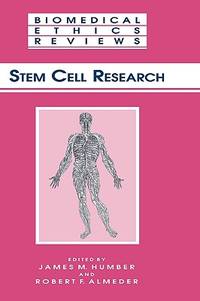
Stock photo: cover may vary
STEM CELL RESEARCH Hardback - 2003
by James M. Humber (Editor); Robert F. Almeder (Editor)
- New
NZ$95.54
NZ$26.50
Delivery to USA
Standard delivery: 7 to 14 days
More delivery options
Standard delivery: 7 to 14 days
Details
- Title STEM CELL RESEARCH
- Author James M. Humber (Editor); Robert F. Almeder (Editor)
- Binding Hardback
- Edition U. S. EDITION
- Condition New
- Pages 183
- Volumes 1
- Language ENG
- Publisher Humana
- Publication date 2003-10-20
- Features Bibliography, Index
- Bookseller's Inventory # BIBNNA-11312
- ISBN 9781588294012 / 1588294013
- Weight 1.09 lbs (0.49 kg)
- Dimensions 9.16 x 6.24 x 0.77 in (23.27 x 15.85 x 1.96 cm)
- Category Medical / Nursing
- Library of Congress subjects Stem Cells, Stem cells - Research - Moral and ethical
- Library of Congress Catalogue Number 2003009570
- Dewey Decimal Code 174.28
- Quantity available 1
About Students Textbooks India
Specialising in: International Edition., Textbooks
Biblio member since 2009
Selling textbooks, International editions and reference books online from last 5 Years.
30 day return guarantee, with full refund including shipping costs for up to 30 days after delivery if an item arrives misdescribed or damaged. Return address: Students_Textbooks 12 phankha road Jankpuri New Delhi 110036 India
Reader reviews for STEM CELL RESEARCH
Write a review for this book
Important Terms and Guidelines
- Please focus on the book’s content and context. Also, add any personal comments as to how you enjoyed the book. Substantiate your likes and dislikes. You may make comparisons to other books.
- Reviews must be at least 140 characters in length.
- Please do not reveal critical plot elements.
- This is not a help line. Contact customer support if you need help.
Your review must not include:
- Obscenities, discriminatory language, or other insulting language not suitable for public domain
- Advertisements, “spam” content, or references to other products, offers or websites.
- Email addresses, URLs, phone numbers, physical addresses or other contact information.
- Overly critical comments about other reviews or reviewers
- Time-sensitive material (i.e. promotional tours, seminars, lectures, etc.)
- Availability, price, or alternative ordering/shipping information
From the publisher
First line
Michael S. Gazzaniga, director of the Center for Cognitive Neuroscience at Dartmouth College, argued that in using embryos for research, scientists should regard them the way doctors look upon organs for transplant.
From the rear cover
Stem cell research holds high promise of providing powerful new treatments for a number of debilitating diseases, even while it raises for some-as a form of human experimentation-a number of difficult moral problems. In Stem Cell Research, a well-seasoned panel of philosophers, ethicists, feminists, and historians examine these moral issues and introduce the principal arguments for and against such research. Among difficult issues considered are these: What reason (or reasons) are there for believing that human embryonic stem cells should (or should not) be accorded the protections ordinarily extended to full members of the human moral community? Would it be wrong to experiment with stem cells taken from human embryos, knowing that such experimentation would lead to the destruction of the embryos, even if they were about to be destroyed and discarded? Does the current use of human embryonic stem cells in research devalue humanity by treating these materials as mere "commodities"? Finally, are the current regulations on stem cell research unjust because they alienate women from their reproductive labor?
Broad in scope and objective in its coverage, Stem Cell Research offers both a balanced presentation and thoughtful critiques of the main arguments in the debate, allowing readers to reach their own conclusions on all the key moral issues associated with today's stem cell research.
Broad in scope and objective in its coverage, Stem Cell Research offers both a balanced presentation and thoughtful critiques of the main arguments in the debate, allowing readers to reach their own conclusions on all the key moral issues associated with today's stem cell research.

