
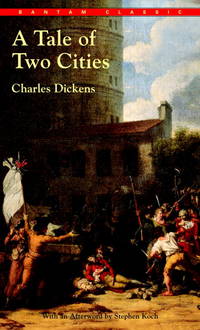

Stock photo: cover may vary
A Tale of Two Cities (Bantam Classics) Mass market paperback - 1989
by Dickens, Charles
- Used
- Acceptable
- Paperback
Dickens's classic tale of the French Revolution brings to life a time of terror and treason, and chronicles a starving people who rise in frenzy and hate to overthrow a corrupt and decadent regime. This 150th anniversary edition features a new Afterword. Revised reissue.
NZ$9.45
Free Delivery within USA
Standard delivery: 4 to 8 days
More delivery options
Standard delivery: 4 to 8 days
Ships from Orion LLC (Texas, United States)
Details
- Title A Tale of Two Cities (Bantam Classics)
- Author Dickens, Charles
- Binding Paperback
- Edition [ Edition: Repri
- Condition Used - Acceptable
- Pages 416
- Volumes 1
- Language ENG
- Publisher Bantam Classics, New York, New York, U.S.A.
- Publication date 1989-06-01
- Features Bibliography, Table of Contents
- Bookseller's Inventory # 0553211765-4-18559987
- ISBN 9780553211764 / 0553211765
- Weight 0.45 lbs (0.20 kg)
- Dimensions 6.9 x 4.2 x 1 in (17.53 x 10.67 x 2.54 cm)
- Size 4x0x6
- Reading level 1130
-
Themes
- Chronological Period: 18th Century
- Chronological Period: 1800-1850
- Cultural Region: French
- Topical: Home School
- Category Literature - Classics / Criticism
- Library of Congress subjects Historical fiction, War stories
- Library of Congress Catalogue Number 00002549
- Dewey Decimal Code FIC
- Quantity available 4
About Orion LLC Texas, United States
About this book
Written by Charles Dickens, A Tale of Two Cities is a historical novel that follows Manette, a French doctor imprisoned for 18 long years in Paris’s Bastille. Following his release, he goes to live in London with his daughter Lucie, who had never met him and believed him to be dead. Set in London and Paris before and during the French Revolution and Reign of Terror, A Tale of Two Cities is a fictitious story that falls both into the historical and adventure genres. The famous book is one of the bestselling novels of all time, both for the atmosphere that Dickens’ creates and the tension he weaves. Full of love and brutality, A Tale of Two Cities exposes the highs and lows of humanity.
Reader reviews for A Tale of Two Cities (Bantam Classics)
Write a review for this book
Important Terms and Guidelines
- Please focus on the book’s content and context. Also, add any personal comments as to how you enjoyed the book. Substantiate your likes and dislikes. You may make comparisons to other books.
- Reviews must be at least 140 characters in length.
- Please do not reveal critical plot elements.
- This is not a help line. Contact customer support if you need help.
Your review must not include:
- Obscenities, discriminatory language, or other insulting language not suitable for public domain
- Advertisements, “spam” content, or references to other products, offers or websites.
- Email addresses, URLs, phone numbers, physical addresses or other contact information.
- Overly critical comments about other reviews or reviewers
- Time-sensitive material (i.e. promotional tours, seminars, lectures, etc.)
- Availability, price, or alternative ordering/shipping information
From the publisher
From the jacket flap
With his sublime parting words, "It is a far, far better thing that I do, than I have ever done..." Sidney Carton joins that exhalted group of Dickensian characters who have earned a permanent place in the popular literary imagination. His dramatic story, set against the volcanic fury of the French Revolution and pervaded by the ominous rumble of the death carts trundling toward the guillotine, is the heart-stirring tale of a heroic soul in an age gone mad. A masterful pageant of idealism, love, and adventure -- in a Paris bursting with revolutionary frenzy, and a London alive with anxious anticipation -- "A Tale of Two Cities is one of Dickens's most energetic and exciting works.
First edition identification
A Tale of Two Cities was first published in 31 weekly installments in a journal called All the Year Round between April and November of 1859, and published in a book form in the same year. The publisher of the first book edition was Chapman and Hall, based in London. Original illustrations were done by H. K. Browne on 16 plates inserted into the book. The first edition is a hardcover, octavo book with maroon cloth covers. However, some first editions have had the binding refurbished. A key way to identify first editions of A Tale of Two Cities is that page 213 is misnumbered as “113.” Additionally, affectionately is misspelled as “affetcionately” on line 12, page 134. Finally, the signature “b” is present on the list of plate illustrations.

