
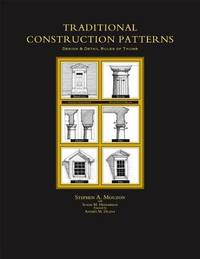
Stock photo: cover may vary
Traditional Construction Patterns: Design and Detail Rules-of-Thumb Paperback - 2004
by Stephen Mouzon
- Used
- Good
- Paperback
NZ$161.72
Free Delivery to USA
Standard delivery: 7 to 10 days
More delivery options
Standard delivery: 7 to 10 days
Dropship order
Ships from Ausvora INC (Connecticut, United States)
Details
- Title Traditional Construction Patterns: Design and Detail Rules-of-Thumb
- Author Stephen Mouzon
- Binding Paperback
- Edition First Edition.
- Condition Used - Good
- Pages 312
- Volumes 1
- Language ENG
- Publisher McGraw Hill, Blacklick, Ohio, U.S.A.
- Publication date 2004-08-01
- Illustrated Yes
- Features Bibliography, Illustrated, Index, Table of Contents
- Bookseller's Inventory # ANAIS-0071416323
- ISBN 9780071416320 / 0071416323
- Weight 1.62 lbs (0.73 kg)
- Dimensions 10.92 x 8.36 x 0.63 in (27.74 x 21.23 x 1.60 cm)
- Size 0x0x0
- Category Architecture
- Library of Congress subjects Architecture, Building
- Library of Congress Catalogue Number 2003070171
- Dewey Decimal Code 721
- Quantity available 1
About Ausvora INC Connecticut, United States
Biblio member since 2025
We are a U.S.-based online bookstore specializing in quality used books at affordable prices. With over 1 million books in stock, we serve readers, resellers, libraries, and institutions across the United States and internationally.
Fast & Reliable Shipping All orders ship within 1–2 business days. Domestic shipping across the U.S. via USPS or UPS. International shipping available to most countries. 🔁 30-Day Hassle-Free Returns If the book isn't as described, we'll make it right. Enjoy a full 30-day return window with no questions asked.
Reader reviews for Traditional Construction Patterns: Design and Detail Rules-of-Thumb
Write a review for this book
Important Terms and Guidelines
- Please focus on the book’s content and context. Also, add any personal comments as to how you enjoyed the book. Substantiate your likes and dislikes. You may make comparisons to other books.
- Reviews must be at least 140 characters in length.
- Please do not reveal critical plot elements.
- This is not a help line. Contact customer support if you need help.
Your review must not include:
- Obscenities, discriminatory language, or other insulting language not suitable for public domain
- Advertisements, “spam” content, or references to other products, offers or websites.
- Email addresses, URLs, phone numbers, physical addresses or other contact information.
- Overly critical comments about other reviews or reviewers
- Time-sensitive material (i.e. promotional tours, seminars, lectures, etc.)
- Availability, price, or alternative ordering/shipping information
From the publisher
First line
PATTERNS in architecture are much like words in a spoken language.
From the rear cover
Publisher's Note: Products purchased from Third Party sellers are not guaranteed by the publisher for quality, authenticity, or access to any online entitlements included with the product.
"Steve Mouzon ... has produced a manual that is clear, easy to use, and targeted to the most common errors ... Traditional architects can now sweep their own house clean." -- Andres Duany, Architect & Planner
"Steve Mouzon ... has produced a manual that is clear, easy to use, and targeted to the most common errors ... Traditional architects can now sweep their own house clean." -- Andres Duany, Architect & Planner
Looking at a building and seeing a building are two very different things. To truly understand traditional architecture you must train your eye to see the difference between the Dos and Don'ts. Steve Mouzon's beautifully illustrated book provides an essential resource for anyone seeking this knowledge." -- Marianne Cusato, Author
"... to see a town or a building through the eyes of a gifted architect like Steve Mouzon is to truly experience it ... this book is an inspiration to building our world better again ..." -- Kristen Payne, Southern Living
...absolutely essential ... a new town or new neighborhood is simply more profitable when the architecture is correct ..." -- Nathan Norris, Developer
"... the first book in my library and the only book I take into the field ..." -- James B. Wagnon, Jr., Historical Home Crafters, Inc.
This book explains, in layman's terms, the vague sense of unease we've all had with traditional architecture done incorrectly for the past half-century, and provides the tools for doing it right again. The first tool is a fully illustrated Lexicon of nearly 240 terms we should all know, but probably don't. It's hard to ask for something if you don't know what to call it. It's also hard to say it if you don't know how to pronounce it, so the Lexicon provides pronunciation of all of the words that are not obvious.
The primary tool, however, is a collection of 108 patterns illustrated as Dos and Don'ts with diagrams and photographs. These patterns represent the most common errors of traditional construction, and are the things we really need to start getting right if we hope to build more of the most-loved places again.
Media reviews
Citations
- Choice, 03/01/2005, Page 1220

