
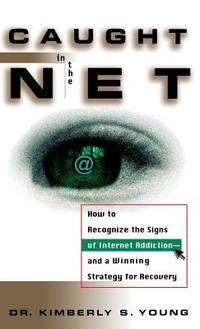
Stock photo: cover may vary
Caught in the Net: How to Recognize the Signs of Internet Addiction--And a Winning Strategy for Recovery Hardback - 1998 - 1st Edition
by Kimberly S. Young
Add to wish list
Reader reviews for Caught in the Net: How to Recognize the Signs of Internet Addiction--And a Winning Strategy for Recovery
Write a review for this book
Important Terms and Guidelines
- Please focus on the book’s content and context. Also, add any personal comments as to how you enjoyed the book. Substantiate your likes and dislikes. You may make comparisons to other books.
- Reviews must be at least 140 characters in length.
- Please do not reveal critical plot elements.
- This is not a help line. Contact customer support if you need help.
Your review must not include:
- Obscenities, discriminatory language, or other insulting language not suitable for public domain
- Advertisements, “spam” content, or references to other products, offers or websites.
- Email addresses, URLs, phone numbers, physical addresses or other contact information.
- Overly critical comments about other reviews or reviewers
- Time-sensitive material (i.e. promotional tours, seminars, lectures, etc.)
- Availability, price, or alternative ordering/shipping information
From the jacket flap
"I don't even help [my children] with their homework in the evening because I'm in the chat rooms, and I don't help put them to bed because I don't realize how late it is. I also don't help them get ready for school in the morning like I used to do because I'm checking my e-mail. And I just can't stop myself." -Raymond, an Internet addict Internet addiction is real. Like alcoholism, drug addiction, or compulsive gambling, it has devastating effects on the lives of addicts and their families: divorce, job loss, falling productivity at work, failure in school, and, in extreme cases, criminal behavior. The problem has already reached epidemic proportions in the United States, and the number of "netaholics" continues to grow rapidly as more households and businesses go on-line. Yet, until now, no one from the mental health community has come forward with a specific description of Internet addiction and its effects or a strategy for treatment and recovery. In Caught in the Net, Kimberly Young shares the results of her three-year study of Internet abuse. Often using the words of the Internet addicts themselves, she presents the stories of dozens of lives that were shattered by an overwhelming compulsion to surf the Net, play MUD games, or chat with distant and invisible neighbors in the timeless limbo of cyberspace. Why is the Internet so seductive? What are the warning signs of Internet addiction? Is recovery possible? Dr. Young answers these questions and many more. She provides a questionnaire to help Net users determine whether they are addicts, and offers concrete steps to help problem users regulate Internet usage and devise a more balanced place for it in their daily lives. For Internet addicts as well as their parents, spouses, friends, and employers, Caught in the Net offers guidance on where and how to seek help from counselors, therapists, and other professionals who take this affliction seriously. For mental health professionals, this book provides insights into the nature and causes of Internet addiction and encourages counselors and therapists to expand their addiction recovery programs to address the specific problems of Internet addicts.
Details
- Title Caught in the Net: How to Recognize the Signs of Internet Addiction--And a Winning Strategy for Recovery
- Author Kimberly S. Young
- Binding Hardback
- Edition number 1st
- Edition 1
- Pages 256
- Volumes 1
- Language ENG
- Publisher Wiley, Hoboken, NJ, U.S.A.
- Publication date 1998-02-27
- Features Bibliography, Index, Table of Contents
- ISBN 9780471191599 / 0471191590
- Weight 0.96 lbs (0.44 kg)
- Dimensions 8.79 x 5.81 x 0.92 in (22.33 x 14.76 x 2.34 cm)
-
Themes
- Topical: Family
- Category Computer - Internet
- Library of Congress subjects Internet addiction
- Library of Congress Catalogue Number 97049070
- Dewey Decimal Code 616.86
